
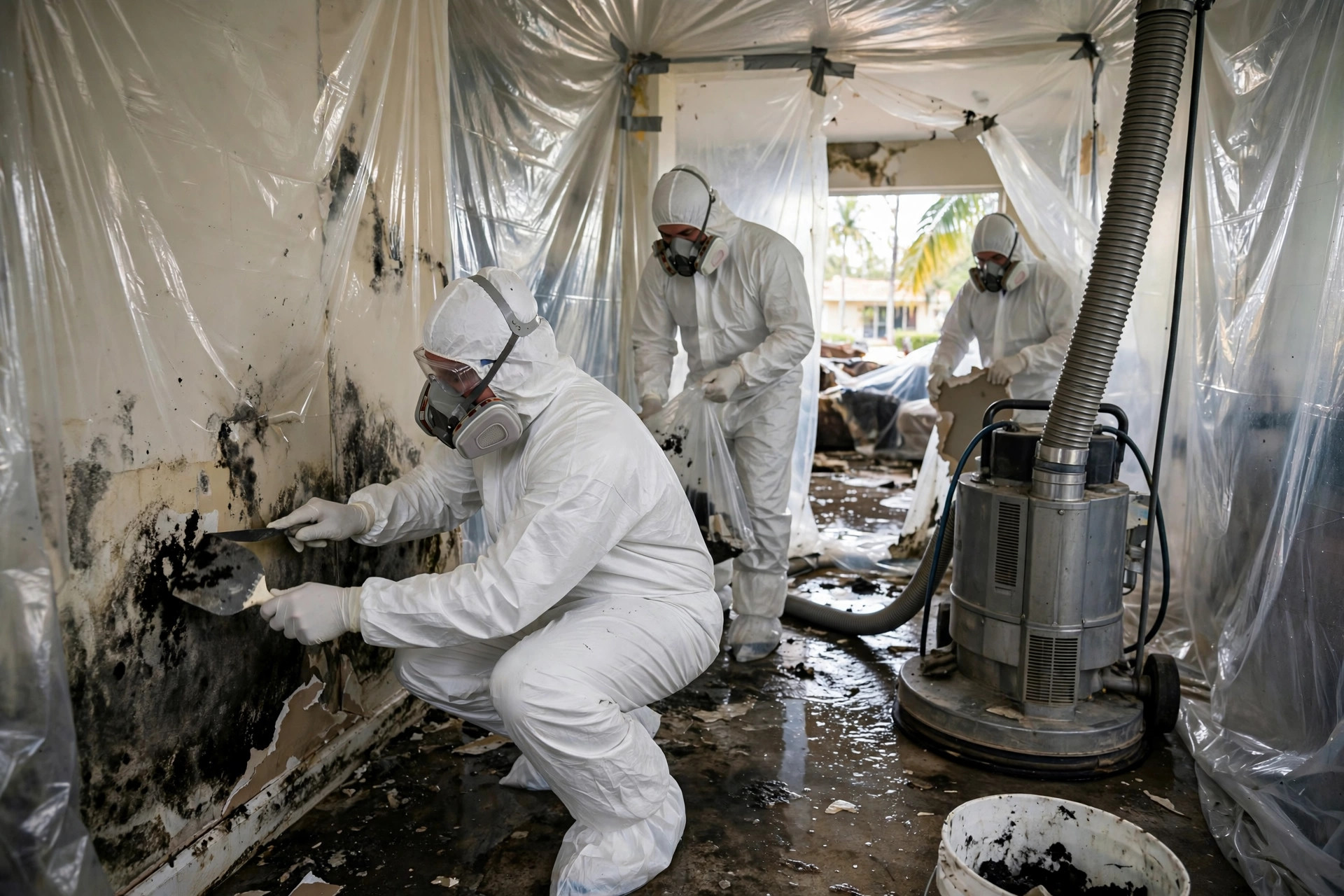
Living and working in Miami means dealing with a tropical monsoon climate: hot, humid summers and sudden heavy downpours that overwhelm drains and raise the water table. When floodwater enters a home in Downtown Miami, Brickell or Little Havana, porous building materials like wood framing, gypsum board and older lath-and-plaster walls can go from wet to mold-colonized in 24–48 hours. In neighborhoods with older housing stock—such as Coconut Grove and Overtown where you’ll find masonry, stucco and mid-century concrete block—mold often hides behind baseboards, in wall cavities and under tile mortar beds. Rapid extraction and thorough drying are critical to stop active spore growth and to limit demolition to only what’s necessary.
Saltwater intrusion after coastal flooding—particularly near Biscayne Bay and Miami Beach—changes the remediation approach. Flood residue containing salts and organic matter accelerates corrosion of metal ties and can promote different microbial growth than freshwater floods; that typically means more aggressive cleaning and replacement of affected porous materials rather than surface-only treatments. Condominiums in the Design District and Brickell also bring access and containment challenges: vertical shafts, shared HVAC plenum risks and HOA coordination require stair/elevator logistics and written containment plans before we open walls. We coordinate with building managers and supply clear documentation for claim submissions and building department inquiries.
Code and safety notes for homeowners: Miami-Dade County and most HOAs expect documented drying and remediation where mold damage could affect adjacent units or common areas. Floodwater categorized as Category 2 or 3 (grey or black water) requires more PPE, disposal controls and often partial demolition because contaminants bind in insulation and porous materials. Expect to inspect subfloors, slab edges and AC drip pans—mold from roof leaks or failing condensate lines often mimics flood mold. We operate on an owner-operated model with set work windows (Mon–Fri 8am–6pm, Sat 9am–2pm) and we provide detailed scope reports so you can see where we removed materials versus where we applied antimicrobial treatments.
Prevention Tips and Seasonal Guidance
- Seasonal vigilance: once summer rains start, monitor crawlspaces, slab perimeter drains and window wells in Coral Gables and Hialeah; rapid surface water can back up through older storm systems.
- Elevate or relocate valuables in ground-floor units in Wynwood and Little Havana during tropical storm watches.
- After any flood event: remove standing water, get airflow across wet surfaces and document damage for insurance.
- For coastal properties near Vizcaya Museum, Bayside Marketplace or Marlins Park, check exterior grading and downspouts; seawall overflow or improper grading is a frequent contributor to basement or slab-edge moisture.
Technician insight
In Miami, the thing that catches most people out with emergency mold remediation after floods in Miami homes is underestimating the role of the high water table and salt-laden coastal flooding. Homes on slab foundations or with old stucco in Coconut Grove and Coral Gables often hide moisture at the slab edge or behind baseboards, and salt contamination forces more aggressive material removal than a freshwater event.
Condo Flood from A/C Overflow in Brickell High-Rise
Problem → A third-floor Brickell condo had a sudden overflow from a shared AC line that soaked the living room and hallway ceilings. What we found → Water had tracked into the ceiling cavity and into the adjacent unit’s shared wall, with visible mold staining and elevated moisture in the drywall. What we did → We coordinated with building management, set up negative air containment on the hall, removed affected drywall back to studs, dried cavities with ducted air movers and provided a remediation report for the HOA. Outcome → Moisture levels were brought back to acceptable readings and the owner received documentation needed for restoration and repainting.
Emergency Mold Remediation After Floods in Miami Homes Services We Offer
✓Emergency Containment and Air Filtration
Set up negative air pressure, HEPA filtration and containment barriers to stop mold spores spreading in multi-family buildings like Brickell high-rises or Wynwood walk-ups.
✓Floodwater Extraction and Moisture Mapping
Rapid removal of standing water followed by infrared and moisture-probe mapping of walls, floors and ceilings to locate hidden wet pockets common in older Coconut Grove and Overtown homes.
✓Selective Demolition and Structural Drying
Targeted removal of unsalvageable drywall, insulation and baseboards plus commercial dehumidification and air movers to dry structural cavities without wholesale tear-out.
✓Saltwater and Contaminated Water Cleanup
Specialized cleaning protocols for seawater or blackwater floods near Miami Beach and Biscayne Bay that remove corrosive residue and biological contaminants before reconstruction.
✓Hidden-Mold Inspection and Bulkhead/Crawlspace Remediation
Access and remediate mold in crawlspaces, slab edges and bulkheads frequently affected by high water table and poor grading in Coral Gables and nearby Hialeah properties.
✓Post-Remediation Clearance Documentation
Provide visual documentation and moisture readings after drying and removal so homeowners and HOAs in Downtown Miami, Design District and Little Havana have records for claims and approvals.
How it works
- 1
Immediate assessment and safety triage
We arrive, confirm occupant safety, classify the floodwater (clean/grey/black), and identify immediate hazards—electrical, structural, or sewage—so we can plan containment and PPE needs.
- 2
Containment and source control
Establish negative-pressure containment, seal off HVAC pathways and stop ongoing water entry (temporary pumps, tarp or diversion) to prevent cross-contamination to adjacent units or rooms.
- 3
Removal, cleaning and drying
Remove saturated porous materials as required, extract standing water, apply appropriate antimicrobial cleaning for the flood type, and deploy commercial dehumidifiers and air movers to reach target moisture levels.
- 4
Verification and reporting
Measure moisture and document clearance conditions with photos and readings, provide a remediation report for insurance or building management, and advise on repairs to prevent recurrence.
Pricing
Emergency mold remediation after a flood typically begins with an emergency-response fee plus remediation costs; complexity increases with hidden mold, saltwater contamination, multi-unit containment, or required structural removals.