
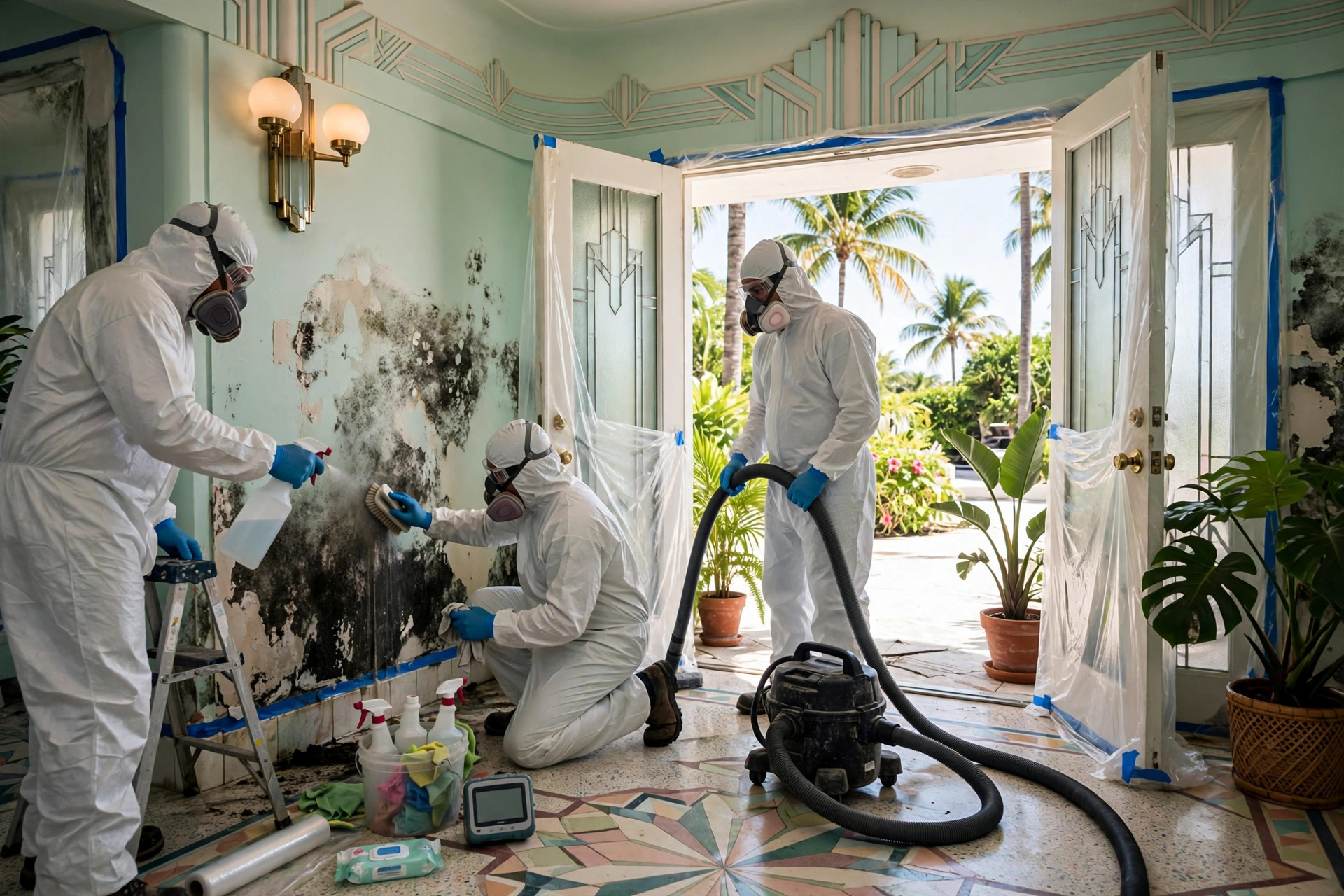
Why Miami Beach needs specialized mold remediation
Miami Beach sits at the edge of Miami-Dade County with a tropical monsoon climate: hot, humid summers and frequent heavy rain that drives interior humidity and raises the risk of concealed mold growth. Properties here range from historic Art Deco apartments near Ocean Drive to mid-century bungalows in North Beach and large beachfront high-rises. Salt-laden air and high baseline humidity accelerate timber and drywall deterioration and can hide mold behind baseboards, in balcony drains, and inside HVAC systems. Effective remediation here means accounting for sea-spray corrosion, continuous vapor pressure in wall cavities, and the way ocean breezes change drying patterns across floors and elevations.
Typical materials and tricky spots we inspect
We focus on the materials common in Miami Beach: gypsum board, engineered wood floors, stucco facades, and wrapped ductwork. Mold often colonizes where moisture meets organic substrate — behind tiled bathroom walls with grout failures, under kitchen cabinets with slow plumbing leaks, inside stucco weeps that trap wind-driven rain, and in elevated soffits on older buildings. Also, perimeter slab edges and balcony drains frequently back up in heavy storms, forcing water into building assemblies. Remediation plans must include moisture mapping with hygrometers, invasive inspection where needed, and targeted demolition only where mold is active, not just present.
Code, coordination and occupant safety in coastal condos
Working in Miami Beach frequently means coordinating with condo boards, property managers, and building engineers because remediation can trigger condominium rules and require work-hour windows. For occupied units we set up negative-pressure containment and HEPA filtration to protect neighbors; for larger buildings we stage work near service elevators and use walk-off mats to limit tracking of spores. We also pay attention to HVAC zoning — a single contaminated return can recirculate spores through multiple units. Occupant safety steps, clear signage, and daily progress updates are standard practice during each remediation project.
Repair-first mindset and preventing recurrence
Mold remediation here is not just removal but making sure the underlying moisture problem is fixed. That can mean replacing failed waterproofing at balcony terminations, reconfiguring roof drainage to avoid ponding, correcting gutter or downspout routing in properties near Vizcaya or Bayside Marketplace where wind-driven rain is common, or sealing slab perimeter cracks in older Coral Gables and Coconut Grove homes. We outline the repair work needed, document moisture reads until they return to acceptable levels, and provide guidance for ongoing maintenance in Miami’s humid environment so customers can reduce the chance mold returns.
Technician insight
In Miami, the thing that catches most people out with mold remediation Miami Beach is the combination of salt air and constant humidity—what looks like cosmetic staining often ties back to failed balcony terminations or clogged weep holes. Homeowners assume drying alone fixes it, but unless you address the source—often wind-driven rain or slab-edge leaks—the mold will return.
Mold under a North Beach balcony
Problem → A tenant reported musty odors and peeling paint under a third-floor balcony in North Beach. What we found → Inspection revealed water intrusion at the balcony termination and mold growth inside the adjacent drywall cavity. What we did → We set containment, removed affected drywall and damaged framing elements, sealed the balcony termination and regraded the deck drainage, then dried and cleared moisture readings. Outcome → The unit passed post-remediation checks and the condo board approved the repair scope to prevent recurrence.
Mold Remediation Miami Beach Services We Offer
✓Condo Unit Mold Remediation
Containment and targeted removal for individual units in high-rise buildings around South Beach, Brickell, and Mid-Beach, including coordination with property managers and elevator staging.
✓Bathroom and Shower Mold Removal
Address mold behind tile and drywall caused by failed waterproofing, with tile reinstallation guidance and grout/sealant replacement recommendations to prevent recurrence.
✓HVAC Mold Inspection and Cleaning
Inspection of duct returns and coils for microbial growth in ocean-facing properties and commercial spaces near Bayside Marketplace and Pérez Art Museum, plus HEPA vacuum and coil cleaning where active contamination is found.
✓Balcony, Roof Termination and Flashing Repairs
Targeted remediation where balcony ponding or failed flashings introduce moisture into exterior walls — we remove affected materials and outline watertight repair methods suitable for coastal exposure.
✓Attic and Crawl Space Mold Remediation
Moisture mapping and remediation in attics and shallow crawl spaces common to Coconut Grove and Little Havana properties, including recommendations for improved ventilation and vapor control.
✓Post-Flood Mold Remediation
Rapid response mitigation after storm-related flooding or plumbing failures in Miami Beach and nearby Hialeah, focusing on rapid drying, salvage decisions, and microbial control to limit spread.
✓Commercial Mold Remediation
Remediation for storefronts, restaurants and galleries in Wynwood, the Design District and downtown, with containment plans that minimize business disruption and protect inventory and art.
How it works
- 1
Initial assessment and moisture mapping
We inspect the unit or building, probe suspect materials, and record moisture and humidity readings to determine active growth versus staining. Photos and a scope are provided so condo boards or property managers understand proposed work.
- 2
Containment and air management
We set up negative-pressure containment and HEPA filtration appropriate to the job size, seal off vents or adjacent units as needed, and establish decontamination zones to prevent cross-contamination in multi-unit buildings.
- 3
Removal and cleaning
Only materials with active mold growth are removed, with careful demolition of affected drywall, insulation, or finishes. Structural framing and remaining surfaces are cleaned with HEPA vacuums and antimicrobial treatments as appropriate.
- 4
Drying, repairs and verification
We run commercial dehumidifiers and air movers until moisture levels stabilize, perform recommended repairs such as flashing or grout replacement, and re-test moisture and surface cleanliness before sign-off.
Pricing
Typical projects range from small bathroom jobs to multi-room condo remediation; cost depends on extent of demolition, accessibility in high-rise buildings, and whether structural repairs or waterproofing are required.